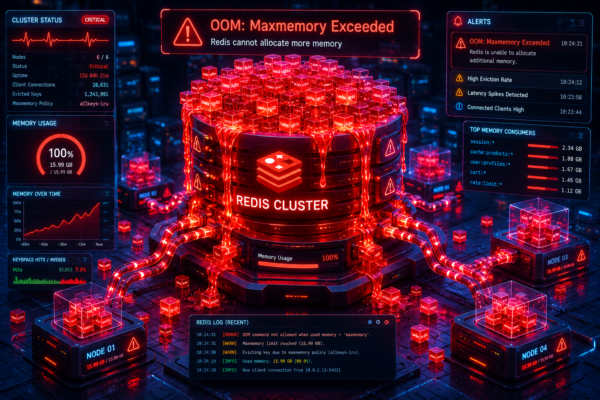


Redis database infrastructure diagram illustrating a maxmemory out of memory error and write command rejections.

Troubleshooting Redis Maxmemory OOM Errors Eviction Policies and Memory Optimization

Redis has become a fundamental pillar of modern full-stack web architectures, serving as a high-performance, in-memory key-value store for caching layers, session management, and pub/sub message brokers. Operating entirely within the host’s RAM allows Redis to deliver sub-millisecond read and write latencies. However, this absolute reliance on memory introduces a critical infrastructure vulnerability: Memory Exhaustion….

Read More
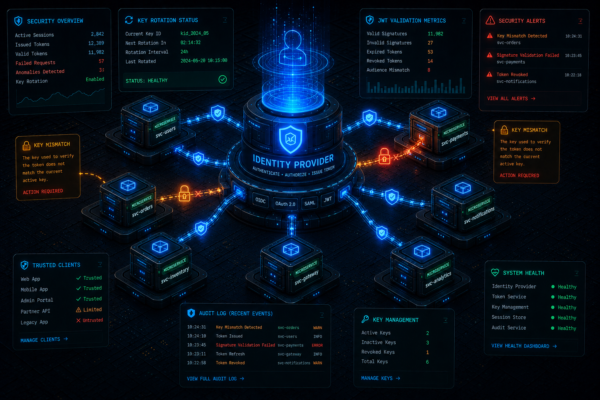
Distributed microservices architecture diagram highlighting JWT verification errors and JWKS public key cache miss vulnerabilities during key rotation.

Resolving JWT Verification Failures in Distributed Microservices Handling JWKS Cache Misses

In decentralized full-stack architectures, securing authentication across independent microservices requires moving away from stateful session validation. Modern enterprise systems rely heavily on stateless JSON Web Tokens (JWT) signed with asymmetric encryption algorithms like RS256. Under this paradigm, a centralized Identity Provider (IdP) holds the private key to sign tokens, while distributed downstream microservices fetch corresponding…

Read More
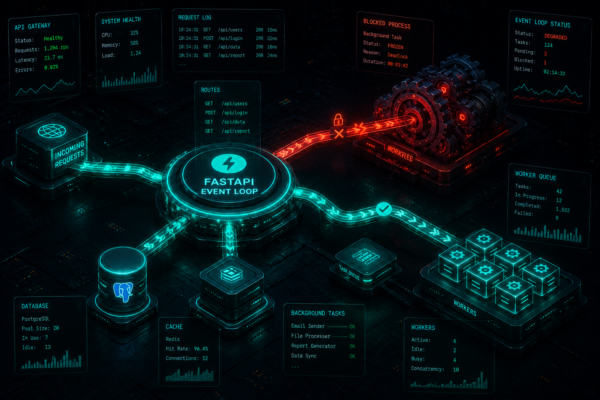
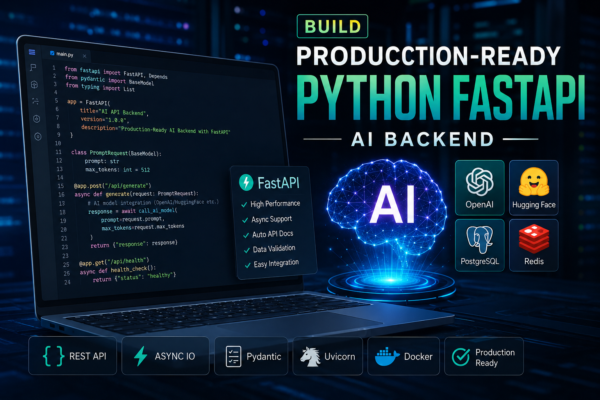
FastAPI infrastructure diagram illustrating a background task blocking the single-threaded asynchronous event loop.

Eliminating FastAPI Event Loop Blocking inside Background Tasks

FastAPI has grown into one of the most popular modern web frameworks for building high-performance AI backends and microservices, thanks to its native support for asynchronous programming (async/await) and standard ASGI servers like Uvicorn. However, scaling a high-throughput FastAPI application often exposes a subtle concurrency bottleneck: Event Loop Blocking. This architectural flaw typically surfaces when…

Read More
MongoDB architecture diagram showing an aggregation pipeline cursor timeout error due to non-indexed blocking stages.

Resolving MongoDB Cursor Timeouts on Large Aggregation Pipelines Architectural Optimization

MongoDB’s aggregation framework is an incredibly robust computation engine for processing large-scale datasets directly within the database layer. However, transitioning heavy analytical workflows from staging environments to high-throughput production datasets frequently exposes an infrastructure bottleneck: the Cursor Timeout. When executing deep pipelines involving complex $group, $lookup, or multi-stage $sort operations on millions of documents, applications…

Read More
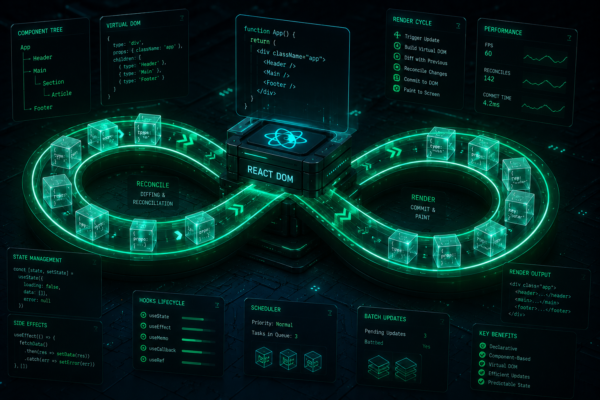
React engineering diagram showcasing a useEffect hook caught in an infinite rendering loop due to object reference mismatches.

Resolving React useEffect Infinite Loops Reference Equality and Dependency Matrix Optimization

React’s functional component paradigm and the Hooks API have completely streamlined frontend state orchestration. However, transitioning from class-based lifecycles to declarative hooks introduces unique optimization traps. Among the most destructive performance bottlenecks in production applications is the useEffect infinite render loop. This anti-pattern typically surfaces silently during development but aggressively compromises client-side runtime operations under…

Read More
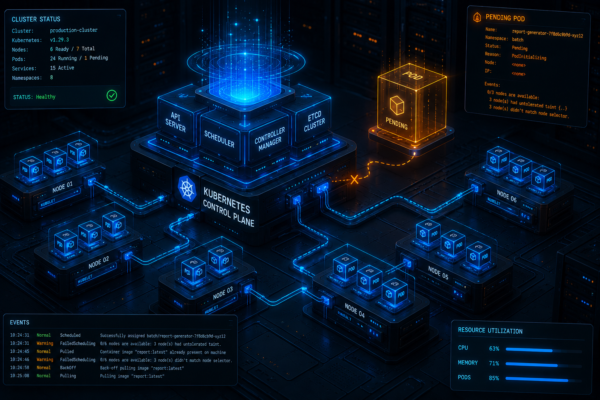
Kubernetes cluster diagram showing a container pod stuck in a pending scheduling state due to resource starvation or taint mismatch.

Deconstructing Kubernetes Pod ‘Pending’ States: Infrastructure Triage and Fixes

Deploying microservices to a Kubernetes (K8s) cluster provides unparalleled scalability and container orchestration. However, when a rolling deployment stalls and your pods get stuck indefinitely in the Pending state, your continuous deployment pipeline grinds to an immediate halt. Unlike runtime execution failures like CrashLoopBackOff or ImagePullBackOff, a Pending state indicates that the Kubernetes scheduler (kube-scheduler)…

Read More
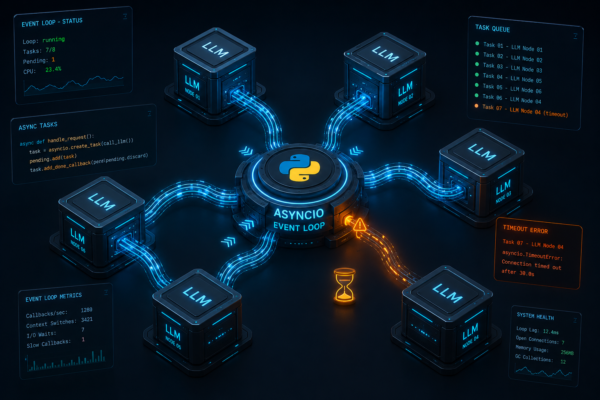
LangChain asyncio timeout error diagram showing an event loop hanging during concurrent LLM orchestration calls.

Mastering LangChain Asyncio Timeouts in Production LLM Orchestration

Building production-grade AI agents and Retrieval-Augmented Generation (RAG) pipelines requires orchestrating multiple LLM calls, vector database queries, and external tool executions simultaneously. To maintain high throughput and low user latency, utilizing asynchronous programming via Python’s asyncio library has become an absolute necessity. However, integrating asyncio with orchestration frameworks like LangChain frequently surfaces a critical vulnerability:…

Read More
Abstract technical diagram representing PostgreSQL connection pool exhaustion and database leaks when deploying Prisma ORM in serverless functions.

Mitigating PostgreSQL Connection Pool Exhaustion in Serverless via Prisma ORM

The shift toward serverless architectures (like AWS Lambda, Vercel, and Netlify) has drastically simplified deployment pipelines and autoscaling. However, pairing a stateless, highly ephemeral serverless function with a traditional stateful relational database like PostgreSQL introduces critical infrastructure challenges. The most common and devastating failure pattern full-stack engineers encounter is database connection pool exhaustion, frequently manifested…

Read More
Next.js hydration mismatch error concept showing server rendered DOM vs client rendered DOM desynchronization code block

Fixing Next.js Hydration Errors

Next.js has revolutionized web architecture by combining the power of Server-Side Rendering (SSR) and Static Site Generation (SSG) with client-side interactivity. However, this hybrid paradigm introduces a unique class of runtime engineering errors, the most notorious being the Hydration Mismatch. If you have ever encountered the cryptic console error: “Hydration failed because the initial UI…

Read More
Conceptual visualization of an optimized Redis connection pool in Node.js backend infrastructure.

Troubleshooting Redis Connection Pool Exhaustion in Node.js Applications

### The Root Cause: Why Redis Exhaustion Happens Unlike standard relational databases (such as PostgreSQL or MySQL) that heavily rely on traditional, long-lived server-side multi-threaded connection pools, Redis operates on a single-threaded event loop architecture. Every command sent to Redis is parsed sequentially. In a Node.js framework, if your API endpoint initiates a brand-new Redis…

Read More