


Mastering LangChain Asyncio Timeouts in Production LLM Orchestration
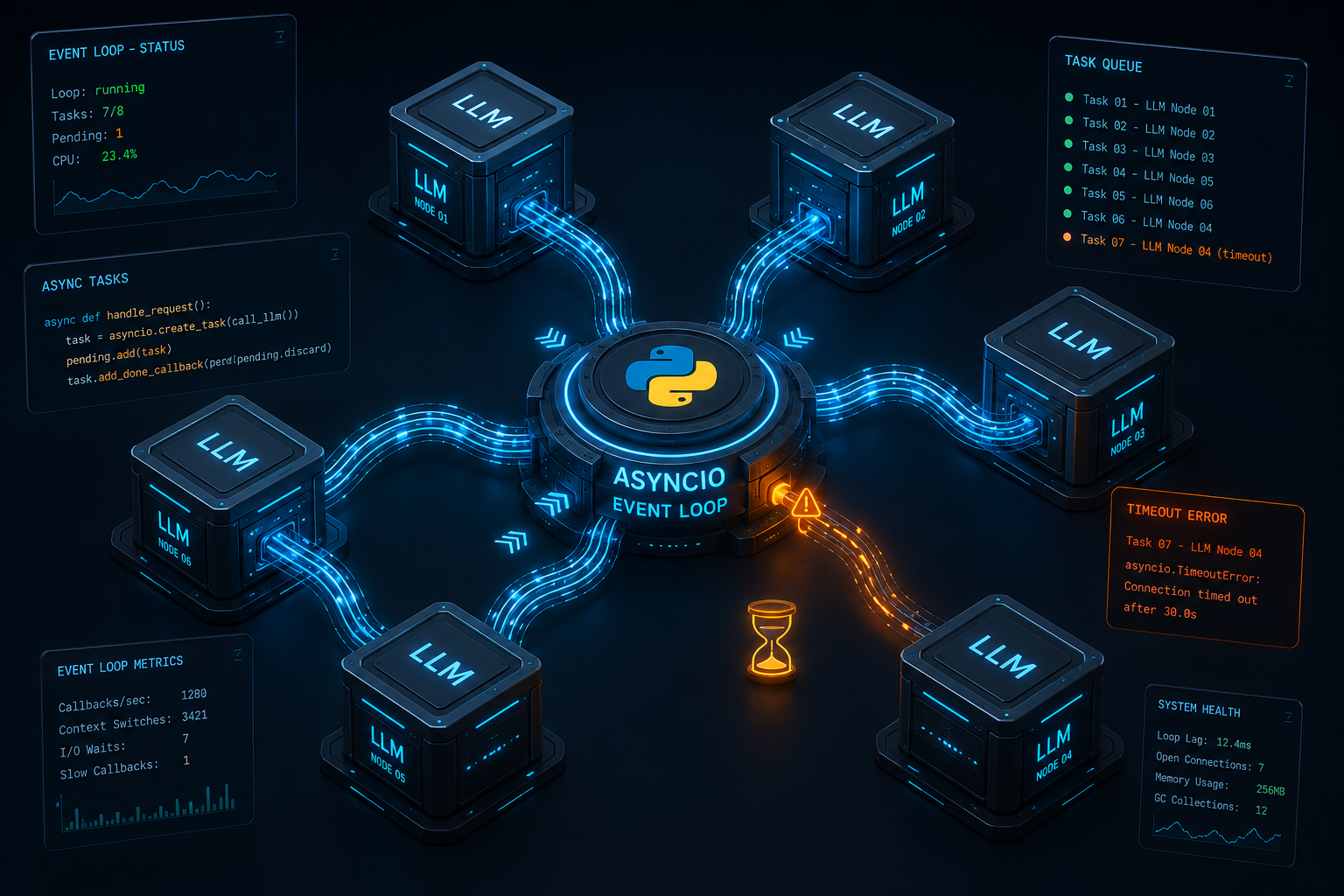
Building production-grade AI agents and Retrieval-Augmented Generation (RAG) pipelines requires orchestrating multiple LLM calls, vector database queries, and external tool executions simultaneously. To maintain high throughput and low user latency, utilizing asynchronous programming via Python’s asyncio library has become an absolute necessity.
However, integrating asyncio with orchestration frameworks like LangChain frequently surfaces a critical vulnerability: unmanaged async timeouts. When upstream LLM providers (like OpenAI, Anthropic, or self-hosted vLLM instances) experience sudden latency spikes or network drops, your concurrent async chains can hang indefinitely, exhausting your application’s connection pool and causing system-wide service failure. Let’s dissect why this happens and implement resilient, production-grade timeout strategies.
The Engineering Problem: Event Loop Blocking and Ghost Hanging
When executing multiple LLM calls concurrently using native LangChain async methods (such as ainvoke, abatch, or astream), developers often rely on asyncio.gather to execute tasks in parallel.
The underlying vulnerability is that by default, if a specific remote API call enters a trailing or un-responsive state, the entire asyncio.gather block remains suspended waiting for that single rogue promise to resolve. Without explicit layer timeouts, a standard HTTP client connection inside LangChain can wait for minutes before raising a network timeout. In high-traffic systems, these unresolved promises rapidly stack up, consuming server sockets, bloating memory footprints, and triggering infrastructure crashes.
The Production Failure Pattern
Consider this common async workflow for an AI agent analyzing financial documents using multiple independent LLM prompt queries:
Python
# agents/financial_analyzer.py
import asyncio
from langchain_openai import ChatOpenAI
from langchain_core.prompts import ChatPromptTemplate

async def extract_financial_metrics(document_chunk: str):
    # CRITICAL FLAW: No explicit timeout configuration on the model layer
    llm = ChatOpenAI(model="gpt-4o")
    prompt = ChatPromptTemplate.from_template("Extract metrics from this data: {data}")
    chain = prompt | llm

    # If the OpenAI endpoint stalls, this execution hangs indefinitely
    return await chain.ainvoke({"data": document_chunk})

async def run_parallel_analysis(chunks: list):
    tasks = [extract_financial_metrics(chunk) for chunk in chunks]
    # Collective execution risks cascading failures if a single call freezes
    results = await asyncio.gather(*tasks, return_exceptions=True)
    return results
If OpenAI experiences a localized rate-limit queue fallback during this execution, your API container will keep the socket alive indefinitely, destroying the application’s response budget.
Production-Grade Engineering Fixes
To build bulletproof AI pipelines, you must apply a multi-layered timeout strategy: model-level configuration and runtime execution wrappers.
Solution 1: Hard Native Model-Level Timeouts
The cleanest architecture requires passing explicit timeout controls directly into the underlying HTTP client abstraction inside the LangChain model constructor. LangChain exposes the request_timeout parameter (or standard timeout in newer abstractions) which maps directly to the base httpx execution layer.
Python
# components/ResilientModel.py
from langchain_openai import ChatOpenAI

# Enforce strict 15-second network limits natively
resilient_llm = ChatOpenAI(
    model="gpt-4o",
    temperature=0,
    timeout=15.0,  # Explicitly drops connection if response stalls
    max_retries=2   # Automatically retries before throwing error
)
Solution 2: Defensive Execution Wrappers via asyncio.wait_for
When orchestration tasks involve third-party vector databases (like Pinecone or Chroma) alongside LLM calls, configure an outer defensive boundary using asyncio.wait_for. This guarantees that regardless of internal code loops, the orchestration process terminates cleanly when the target time budget expires.
Python
# services/OrchestrationEngine.py
import asyncio
from langchain_core.prompts import ChatPromptTemplate
from components.ResilientModel import resilient_llm

async def safe_agent_execution(user_input: str):
    prompt = ChatPromptTemplate.from_template("Analyze infrastructure logs: {logs}")
    chain = prompt | resilient_llm

    try:
        # Enforce an unbreachable 20-second time budget for the entire block
        response = await asyncio.wait_for(
            chain.ainvoke({"logs": user_input}),
            timeout=20.0
        )
        return response.content
    except asyncio.TimeoutError:
        # Graceful fallback logic to prevent application crashes
        return "Error: Downstream AI orchestration exceeded its execution time budget."
Solution 3: Handling Batch Failures with asyncio.as_completed
Instead of letting asyncio.gather stall an entire batch processing cycle, leverage asyncio.as_completed combined with individual task timeouts. This ensures that fast queries return results immediately, allowing your frontend UI to stream partially processed data while isolating failed nodes.
Conclusion
Transitioning an AI integration from a prototype script to an enterprise production system demands strict resource management. By implementing explicit HTTP timeouts in LangChain constructors, safeguarding asynchronous chains with runtime boundaries, and building resilient exception-handling routines, you completely eliminate ghost hanging bugs and secure high-availability infrastructure uptime.
Mitigating PostgreSQL Connection Pool Exhaustion in Serverless via Prisma ORM

One thought on “Mastering LangChain Asyncio Timeouts in Production LLM Orchestration”