


Resolving JWT Verification Failures in Distributed Microservices Handling JWKS Cache Misses
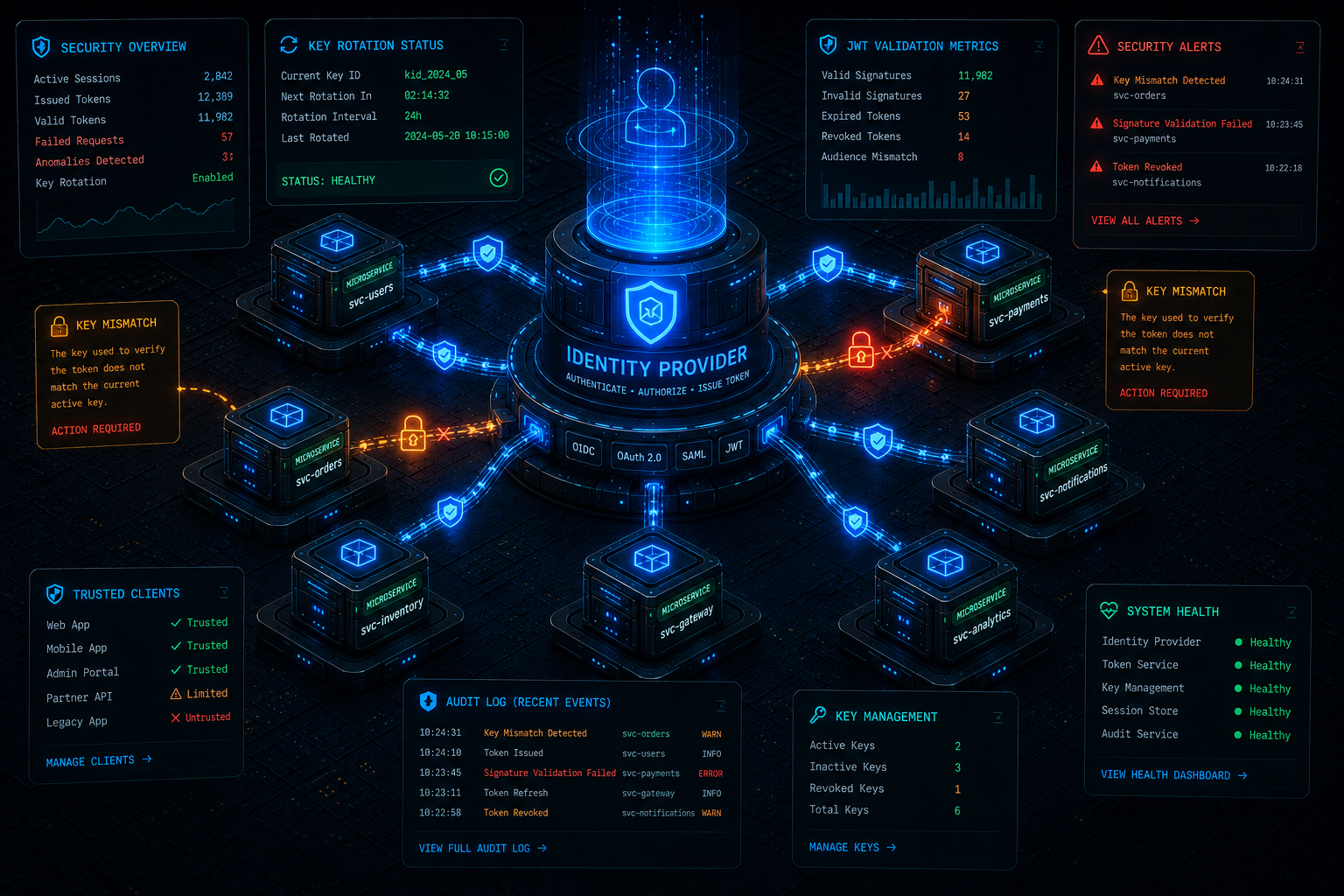
In decentralized full-stack architectures, securing authentication across independent microservices requires moving away from stateful session validation. Modern enterprise systems rely heavily on stateless JSON Web Tokens (JWT) signed with asymmetric encryption algorithms like RS256. Under this paradigm, a centralized Identity Provider (IdP) holds the private key to sign tokens, while distributed downstream microservices fetch corresponding public keys exposed via a JSON Web Key Set (JWKS) endpoint to verify token integrity.
While highly scalable, this model introduces a critical infrastructure race condition: Key Rotation Failures. When the IdP rotates its signing keys due to security compliance or expiration policies, cached verification layers in downstream microservices frequently fail to synchronize in real-time, triggering sudden, cascading 401 Unauthorized errors for authentic public requests. Let’s map out the core engineering problem and implement a zero-downtime synchronization fix.
The Engineering Bottleneck: Stale JWKS Caching
To optimize network performance and reduce validation latency, distributed microservices do not query the IdP’s JWKS endpoint on every incoming HTTP request. Doing so would turn the identity platform into a massive single point of failure and introduce unacceptable API latency overhead. Instead, microservices cache the retrieved public keys in memory.
The critical vulnerability occurs during an automated or emergency key rotation event. The IdP generates a new keypair, appends the new public key to its JWKS array with a unique Key ID (kid), and instantly signs new user tokens with the corresponding new private key.
When a client presents this newly signed token to a downstream microservice, the microservice inspects the token header to locate the kid. If that kid does not exist inside its locally cached public key store, the verification engine fails immediately, rejecting a completely valid user.
The Production Failure Scenario
Consider this typical, poorly configured node verification middleware utilizing standard Express.js and the jwks-rsa abstraction library:
// middleware/auth.js
const { expressjwt: jwt } = require('express-jwt');
const jwksRsa = require('jwks-rsa');

// CRITICAL FLAW: Rigid caching configuration without dynamic refresh limits
const authMiddleware = jwt({
  secret: jwksRsa.expressJwtSecret({
    cache: true,
    rateLimit: true,
    jwksRequestsPerMinute: 5,
    jwksUri: 'https://auth.vorawire.com/.well-known/jwks.json'
  }),
  audience: 'https://api.vorawire.com',
  issuer: 'https://auth.vorawire.com/',
  algorithms: ['RS256']
});

module.exports = authMiddleware;
In this setup, if an emergency token revocation or key rollover occurs, jwksRequestsPerMinute: 5 combined with an aggressive default internal cache max-age means the service will stubbornly reuse its stale in-memory public key matrix for hours, completely blind to the new signing keys deployed on the IdP server.
Production-Grade Resilient Solutions
1. Hardening the JWKS Client with Reactive Cache Fetching
To eliminate authentication drift during key rotations, the client library must be explicitly instructed to dynamically clear its local cache and issue a real-time network request the exact moment an unrecognized kid hits the middleware.
// middleware/hardenedAuth.js
const { expressjwt: jwt } = require('express-jwt');
const jwksRsa = require('jwks-rsa');

const resilientAuthMiddleware = jwt({
  secret: jwksRsa.expressJwtSecret({
    cache: true,
    // Automatically attempt a fresh lookup if a token presents an unknown 'kid'
    cacheMaxEntries: 5,
    cacheMaxAge: 600000, // 10 minutes hard refresh window
    rateLimit: true,
    jwksRequestsPerMinute: 10, // Prevent JWKS endpoint DDoS under high traffic
    jwksUri: 'https://auth.vorawire.com/.well-known/jwks.json'
  }),
  audience: 'https://api.vorawire.com',
  issuer: 'https://auth.vorawire.com/',
  algorithms: ['RS256']
});

module.exports = resilientAuthMiddleware;
2. Implementing Graceful Asymmetric Fallbacks (Multi-Key Support)
During an active key rotation window, your system will simultaneously handle older tokens signed with the expiring key (Key A) and newer tokens signed with the active key (Key B). The JWKS verification engine must maintain a multi-key validation loop to prevent locking out legacy sessions that haven’t expired yet.
// services/validationEngine.ts
import jwt from 'jsonwebtoken';
import { getJwksPublicKeys } from './jwksClient';

export async function verifyDistributedToken(token: string) {
  const decodedToken = jwt.decode(token, { complete: true });
  if (!decodedToken || !decodedToken.header.kid) {
    throw new Error("Invalid JWT token envelope configuration.");
  }

  const targetKid = decodedToken.header.kid;
  // Dynamic fetch that cross-checks cache, falling back to network on miss
  const signingKey = await getJwksPublicKeys(targetKid);

  // Verify token securely using the validated public key structure
  return jwt.verify(token, signingKey.publicKey, {
    audience: 'https://api.vorawire.com',
    issuer: 'https://auth.vorawire.com/'
  });
}
Conclusion
Managing authentication lifecycles in distributed microservices requires syncing your cryptography layer with your networking architecture. By configuring downstream clients to handle unknown key identifiers proactively, restricting internal cache durations, and validating against multi-key arrays, you remove system authentication discrepancies and preserve zero-downtime high-availability security integrity.
Eliminating FastAPI Event Loop Blocking inside Background Tasks


One thought on “Resolving JWT Verification Failures in Distributed Microservices Handling JWKS Cache Misses”